Every sale deed for land in Bangladesh states a value. The government sets a minimum for that value, and land cannot be registered below it (The Daily Ittefaq). The minimum is set for each mouza (মৌজা), a revenue area, and for each class of land, so it is usually called the mouza rate.
In 2025 the government said it planned a new way of setting that minimum, and cut the tax paid when land is sold. The tax cut became law. The new method, as far as we can find, has not yet. This post explains both. It is not legal advice.
How the minimum value is set today
The rules in force are the Fixation of Lowest Market Price of Property Rules, 2010 (সম্পত্তির সর্বনিম্ন বাজার মূল্য নির্ধারণ বিধিমালা, ২০১০). Under the rules as amended in 2015, a committee for each sub-registry office averages the values in registered sale deeds, mouza by mouza and class by class, over 22 months. The Inspector General of Registration can amend abnormal values, and each list stays in force for two years (Bangladesh Gazette, 2015).
The weakness is circular. Most deeds are registered at the mouza rate, often below the real price (The Business Standard). An average of past deeds therefore tends to stay close to the old rate.
How far below? In 2023 the Centre for Policy Dialogue (CPD) compared mouza rates with market prices for nine plots in Dhaka. On average the mouza rate was 29 percent of the market price, from 57 percent in Bosila down to 5 percent on Dhanmondi Road 31 (CPD). CPD’s market prices came from property listing sites, and nine Dhaka plots are not the whole country. CPD also notes a few cases, mostly rural or peripheral, where the mouza rate is above the market price.
What was proposed in 2025
On budget day, 2 June 2025, The Business Standard reported that the government planned to amend the 2010 rules (The Business Standard). Under the proposed system:
- In each mouza, the average value of all deeds for a land category over two years would be calculated.
- Market prices would be set through investigation and public hearings.
- The minimum value would have to match or exceed that average.
- Where prices within a land category differ a lot, a mouza could be divided into clusters.
- Prices would be updated every year and published in the land ministry’s database.
Committees led by divisional commissioners (for city corporation areas) and deputy commissioners (for municipal areas) were reportedly formed to assess land prices and, under the proposal, to split mouzas into clusters (The Business Standard (Bangla)).
This part is still a proposal. Some reports at the time described it as already in effect. As of September 2026 it is not, and the existing mouza rate lists still apply. In Moulvibazar, for example, the lists for 2025 and 2026 were published in December 2024, before the proposal (District Registrar, Moulvibazar). We have found no amended rules in the Gazette, and the Department of Registration’s list of laws still shows the 2015 amendment as the latest (Department of Registration). On 12 June 2026, Finance Minister Amir Khasru Mahmud Chowdhury said a committee had been formed to bring mouza rates closer to market values, and that “a comprehensive survey is needed nationwide” (Dhaka Tribune).
What did change: tax on land sales
When land is sold, a source tax on capital gains is collected at registration, as a percentage of the deed value. The budget speech of 2 June 2025 announced a cut from 8, 6 and 4 percent, depending on location, to 6, 4 and 3 percent, “to ensure property registration at actual sale value” (Budget speech 2025–26). At final approval it was cut again, to 5, 3 and 2 percent (Prothom Alo).
The National Board of Revenue (NBR) notification setting these rates has applied since 1 July 2025. It charges the applicable rate or a fixed amount per decimal (one hundredth of an acre), whichever is higher. The fixed amount runs from Tk 9 lakh (Tk 900,000) per decimal for certain categories of land in Gulshan, Banani, Motijheel and Tejgaon to Tk 500 in upazila (sub-district) areas outside municipalities (NBR). The budget also provided that money received above the deed value, if documents and bank statements show it, is taxed at the capital gains rate (Budget speech 2025–26).
Why it matters
Revenue. Land and flat registrations raised Tk 12,643.3 crore (about Tk 126 billion) in 2023–24, according to NBR figures (The Business Standard). Any part of the price left off a deed escapes the tax collected at registration.
Fairer values, fewer under-declared deeds. A finance ministry official gave an example from one Dhaka mouza: Gulshan Avenue land sells for several times the price of Madani Avenue land, yet its deeds often use the Madani Avenue value (The Business Standard). Where the mouza rate is above the market price, a deed must state more than the land sold for. In May 2025, Finance Adviser Salehuddin Ahmed said that with higher recorded values and lower taxes, “the entire transaction amount can be declared” (The Business Standard). We believe deeds that state real prices would also give valuers and banks better evidence.
Compensation. Under the Acquisition and Requisition of Immovable Property Act 2017, compensation rests on market value. That is the average price of same-class land with equal facilities nearby, in the 12 months before the section 4 notice (the notice that land is proposed for acquisition). Owners get an additional 200 percent for a government purpose, or 300 percent for a private organisation (Laws of Bangladesh). Rules issued in July 2026 set the method: take same-class sale deeds within 500 yards from those 12 months, set aside any above 1.5 times the average or twice the mouza rate, and divide total value by total area (Bangladesh Gazette, 2026). An award can only be as close to real prices as the deeds registered nearby.
What the proposed method would need
Averages by mouza, class and cluster are only as good as the plot-level data behind them.
Each deed tied to the right plot, class and area. A wrong plot number puts a sale in the wrong place, a wrong class puts it in the wrong average, and a wrong area gives the wrong price per decimal.
Clusters drawn on a map. To know which cluster a sale belongs to, you need to know where its plot lies, and a list of plot numbers cannot tell you that. The same goes for a 500-yard vicinity.
Recorded class matching the ground. If the record says paddy and the ground shows houses, a value set from the record is wrong, and so is any average that sale goes into. The 2026 acquisition rules recognise this: officials must record each plot’s actual class and, before the notice, survey the land digitally and take video and still images by drone or other modern technology (Bangladesh Gazette, 2026).
Where our work fits
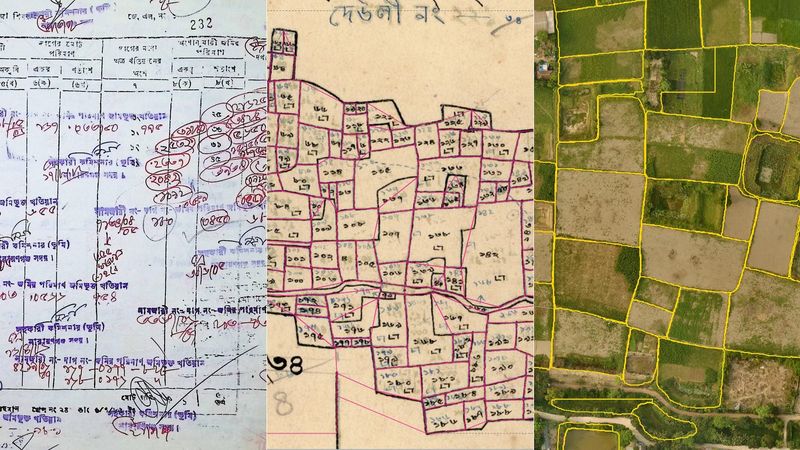
We do not set land values; government committees and officials do. We build tools for the evidence layer underneath: AI that reads khatians (records of rights, খতিয়ান) and mouza maps, with people checking every result, and a model that outlines what is on the ground in the 2025 aerial photos. With that layer, the plot number on a deed can be found on the map and checked against the record and the ground.
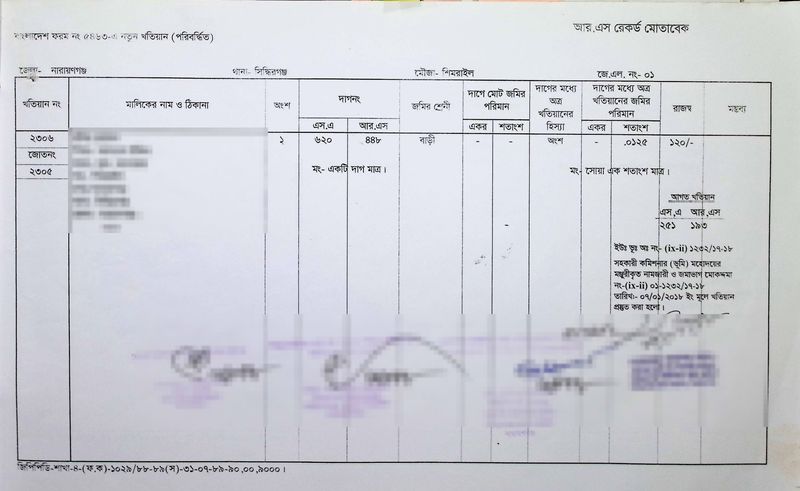
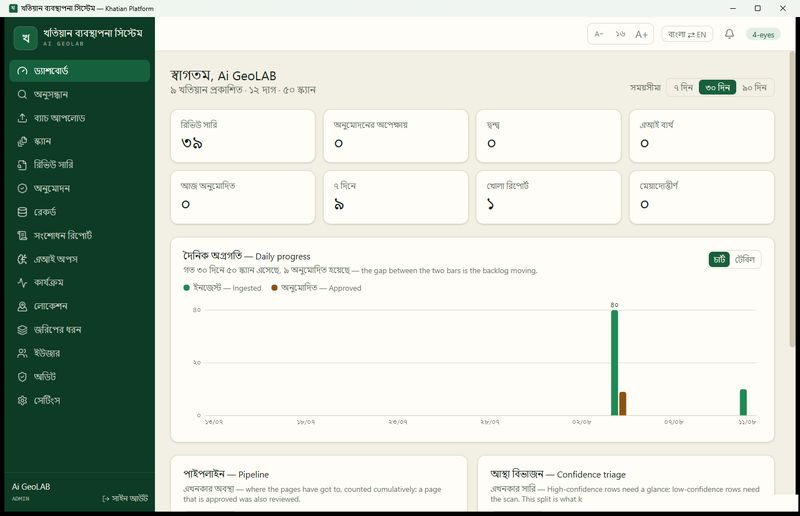
Khatians. Our khatian model reads each owner and their share, every plot (dag) number, the class of land and the area. On 200 khatians per test, from mouzas it never saw during development, it scored 91 out of 100 on the index fields and 93 out of 100 on the full record. Every record goes to a reviewer, and by default a second person approves it.
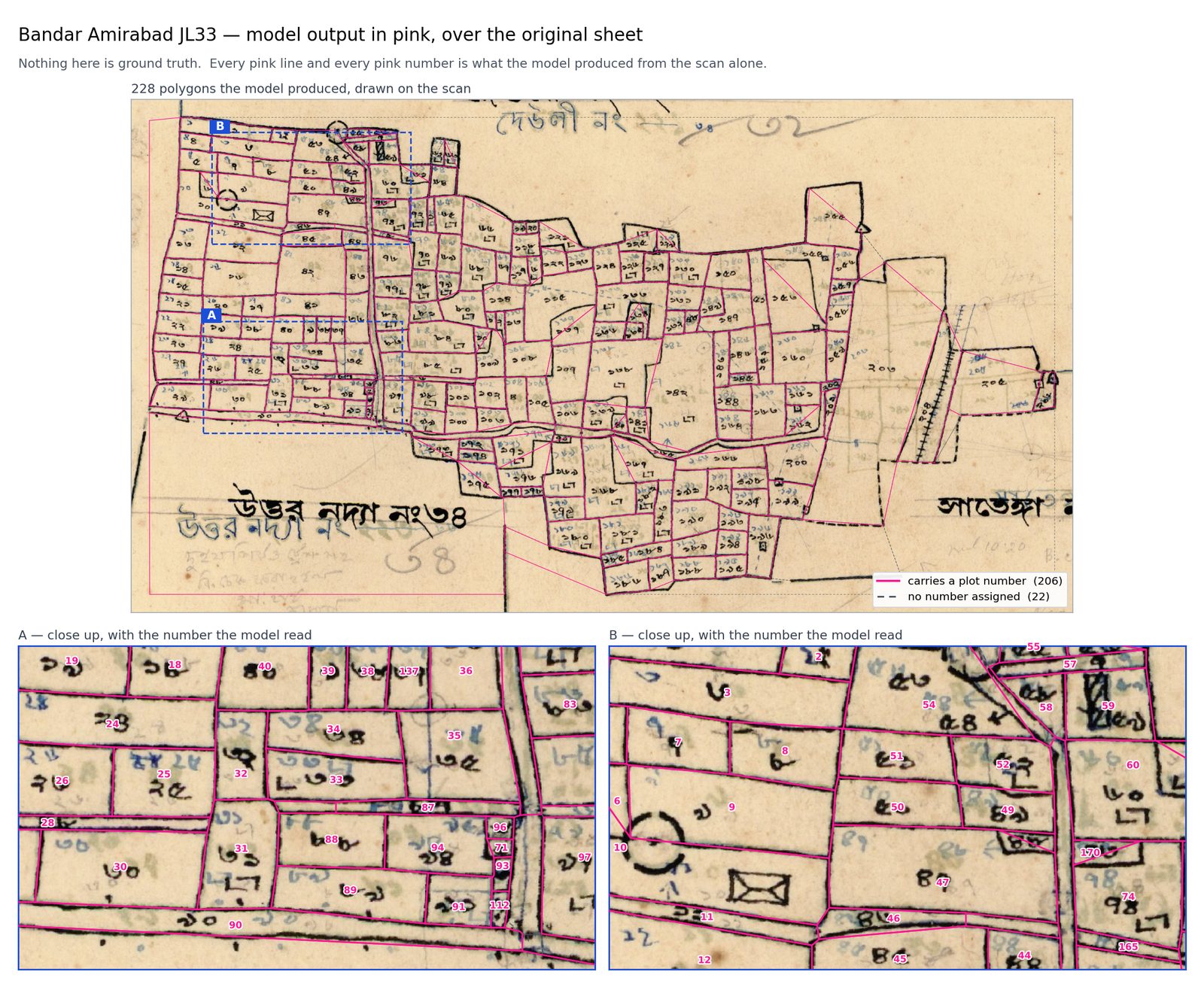
Mouza maps. Our map model turns a scanned mouza sheet into a digital outline for each plot it finds, placed on the ground, with the plot number it read. On 22 sheets it had never seen, with 7,216 plots, it found 95 percent of the plots, and found and read the correct number for 81 percent. Results range from more than nine plots in ten right on the best sheets to fewer than four in ten on the worst, so a reviewer checks every plot. With outlines, clusters can be drawn around real plots, and a deed’s area can be checked against the plot as drawn.
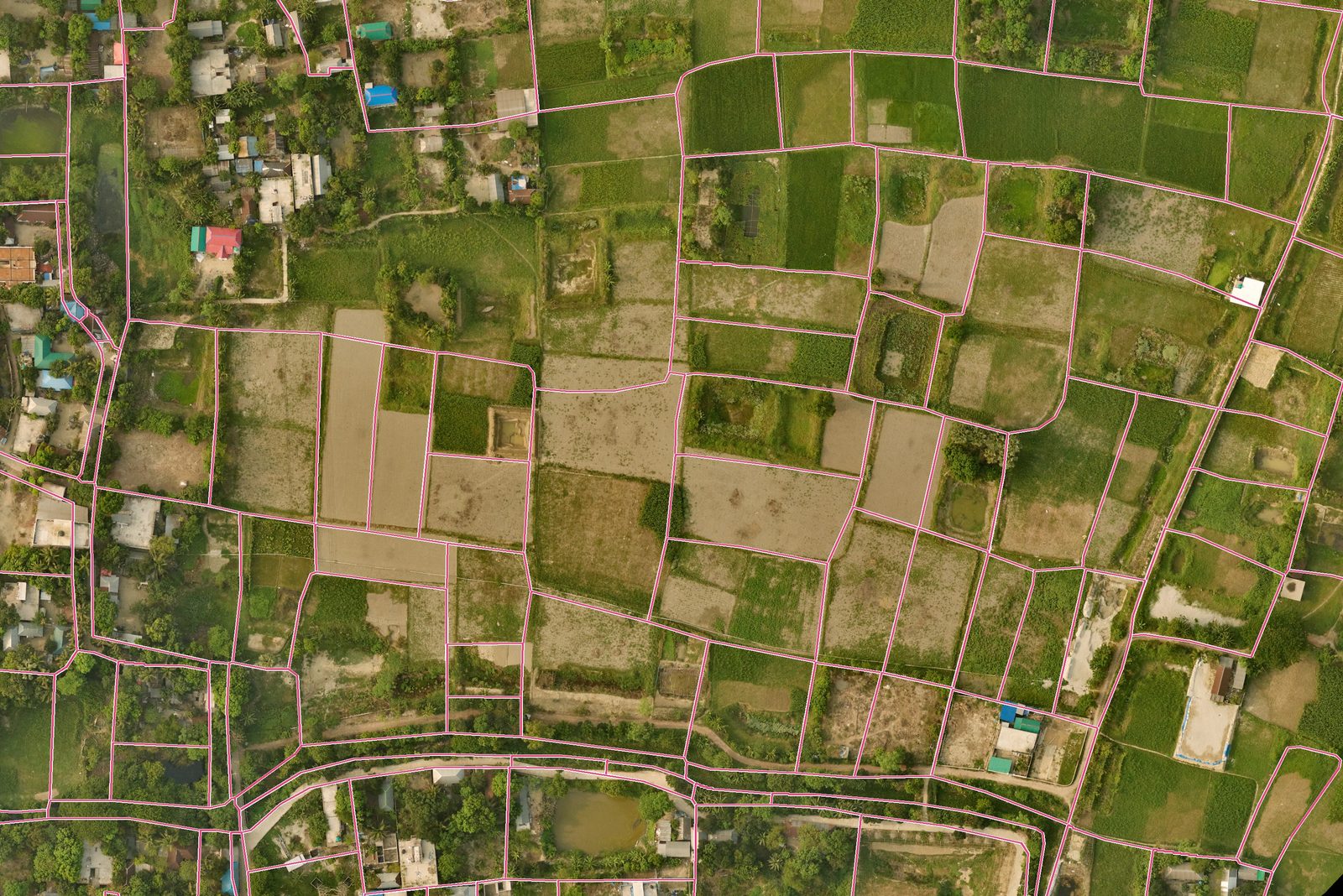
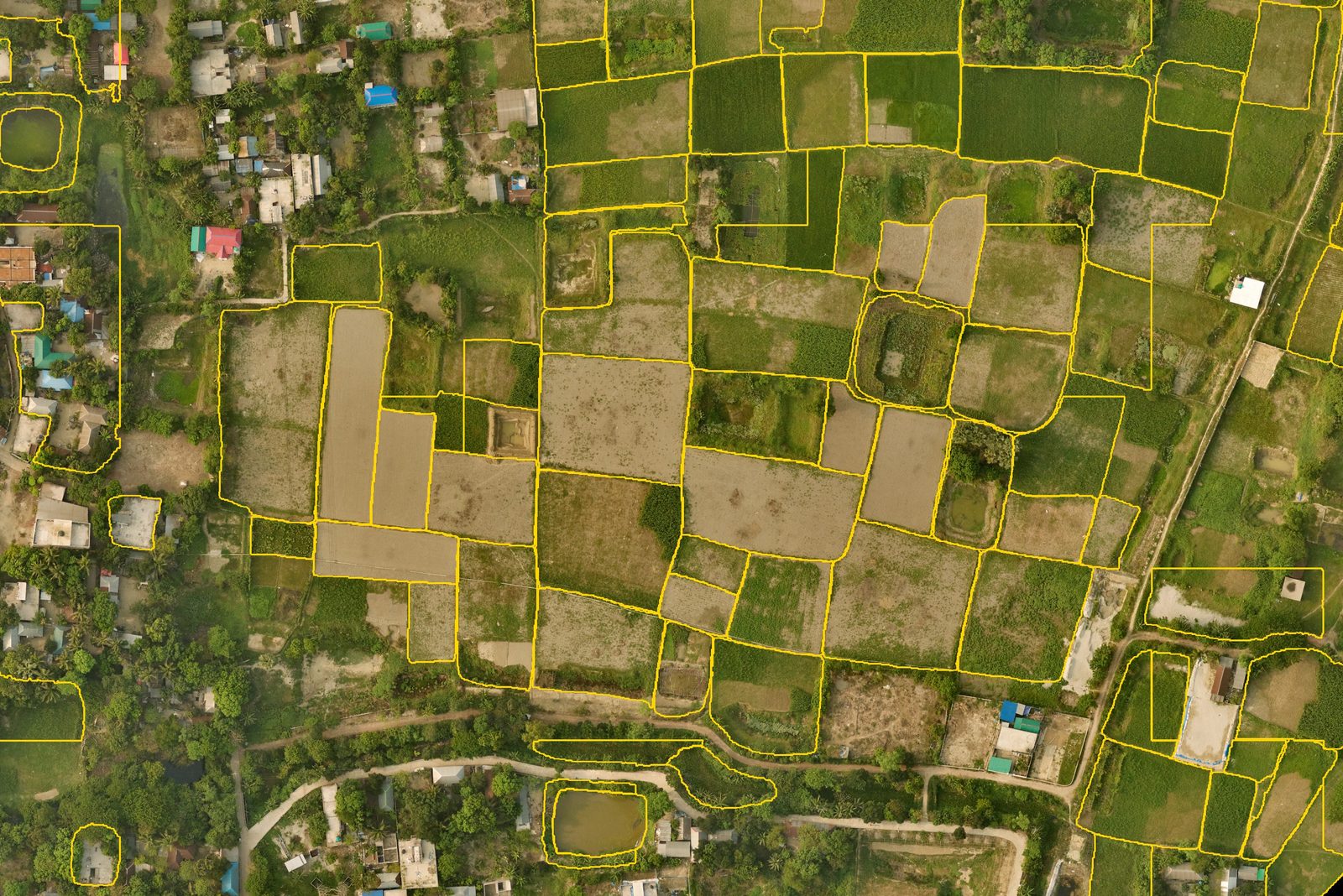
The ground today. Our imagery model outlines fields, ponds, yards and homestead plots in the 2025 aerial photos, taken at 10 centimetres per pixel. On test areas it had never seen, it found 79 percent of the single fields a person had traced, and 78 percent of the fields it drew matched a real field. It works well on farmland and poorly in towns, which matters because the undervaluation examples above are all from Dhaka. We are collecting more labels, including from towns.
The three layers meet in the Khatian Platform, which runs offline on one computer in the office. Selecting a plot shows the active khatians that hold it, and can show what the imagery model found on that ground. A land office can find plots whose recorded class no longer matches the ground before the next round of valuations. A valuer can find comparable plots in the same mouza. A bank can check the record behind a mortgage.
Whatever form the final rules take, we believe they will be only as fair as the records behind them. Our post on three questions behind every fair land value sets out the evidence a fair value needs. To try this on your own mouzas, get in touch.