Land and buildings secure most bank lending in Bangladesh. At the end of June 2026, 63.67 percent of all loans and advances by scheduled banks were outstanding against real estate, more than Tk 11.5 lakh crore (Bangladesh Bank). Bangladesh Bank’s 2016 credit risk guidelines add a caution: collateral is only as good as the lender’s ability to “locate, identify, and legally claim the collateral and eventually sell” it (Bangladesh Bank).
This post is for credit officers, credit risk teams and bank lawyers.
How land collateral is checked today
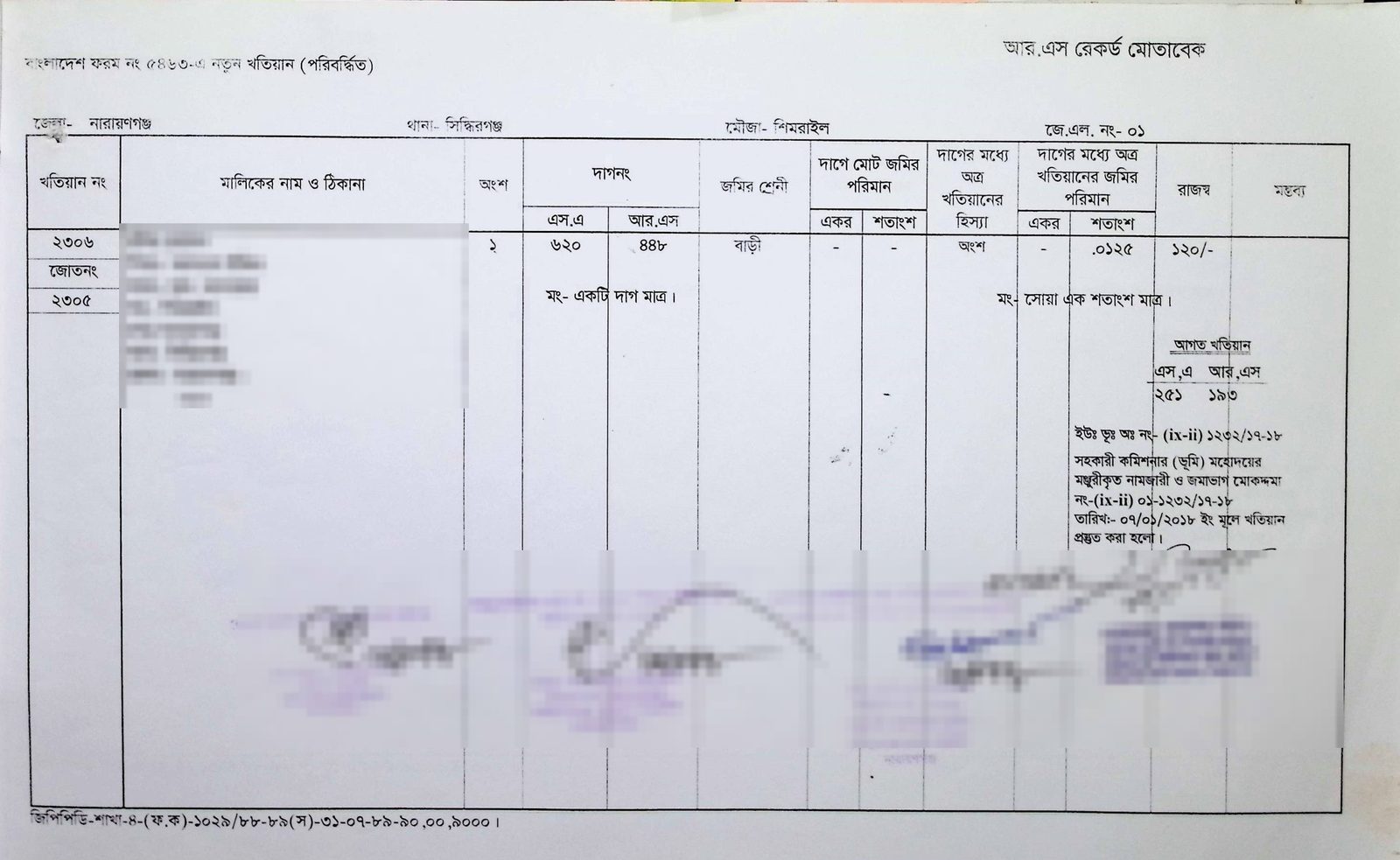
Alongside the title deed and the chain of earlier deeds, the key record is the khatian (খতিয়ান), the record of rights to land. Each khatian belongs to a mouza (মৌজা), the smallest revenue unit, and lists the owners, their shares, the plot (dag) numbers they hold, the class of land and the area. When land changes hands, the record is updated through mutation, or namjari (নামজারি), and a new khatian is issued.
Bangladesh Bank’s guidelines give an indicative checklist for a land mortgage file (Bangladesh Bank). It runs from the original title deed and the earlier (bia) deeds, through the khatians from each survey and a certified mutation khatian with its DCR (duplicate carbon receipt), to a non-encumbrance certificate (NEC), a location map and photograph, a surveyor’s report, a physical visit report by bank officials and a lawyer’s opinion. Banks add their own items: City Bank asks for 25 years of earlier deeds (City Bank), Mercantile Bank for the mouza map (Mercantile Bank).
The mortgage itself must normally be registered under section 59 of the Transfer of Property Act 1882, even when it is made by depositing title deeds with a bank (Laws of Bangladesh).
Since a 2023 amendment to the Bank Company Act 1991, any firm that values collateral for a bank loan must be enlisted with Bangladesh Bank (Laws of Bangladesh). A bank may value the collateral itself for loans of up to Tk 1 crore. From Tk 1 crore an enlisted firm must value it, and from Tk 100 crore at least two firms must value it separately (Bangladesh Bank). Bangladesh Bank published its list of 131 enlisted firms on 7 September 2026 (The Financial Express).
In 2018 Bangladesh Bank also told banks to report collateral to a central database and check it when sanctioning a loan, to stop one property being mortgaged for several loans (Bangladesh Bank).
Each of these checks is made by a different person, from a different set of papers.
Where the checks break
Papers can be forged. In 2024 the Criminal Investigation Department (CID) of the police broke up a syndicate that, it said, had connections in land offices, sub-registry offices, banks and the national ID office. The CID chief said they had found evidence that “seven different bank loans were given against a single flat through forging documents” (The Business Standard). In 2022 the Rapid Action Battalion said a man it had arrested had taken a Tk 15 crore loan from a private bank years earlier, against land belonging to the Roads and Highways Department, beside the Dhaka–Mymensingh highway in Uttara. He had made a forged record of the land in 2006 (Prothom Alo).
The same land can be pledged twice. When the Ministry of Land launched its online Mortgage Data Bank in November 2022, the land minister said many owners mortgaged the same land several times over (The Business Standard).
Values can be inflated. In a 2025 case, three auctions of six acres of mortgaged land drew no bidders. The bank’s own lawyer said its valuation of Tk 156 crore far exceeded the market price, which he put at Tk 70–75 crore (The Business Standard).
The land may not sell. As of August 2025, lenders had filed about 9,400 applications with the money loan courts (Artha Rin Adalat) for possession certificates over mortgaged property, tied to nearly Tk 86,000 crore of defaulted loans, after repeated auctions found no buyers. According to bank officials, such auctions often fail because properties are overpriced, caught in family or inheritance disputes, or include government (khas) land (The Business Standard).
Many of these failures come back to three plain questions about the land. Who owns it, and how much of it? Where exactly is it, and how big is it? What is on it today?
Three records, kept in three places
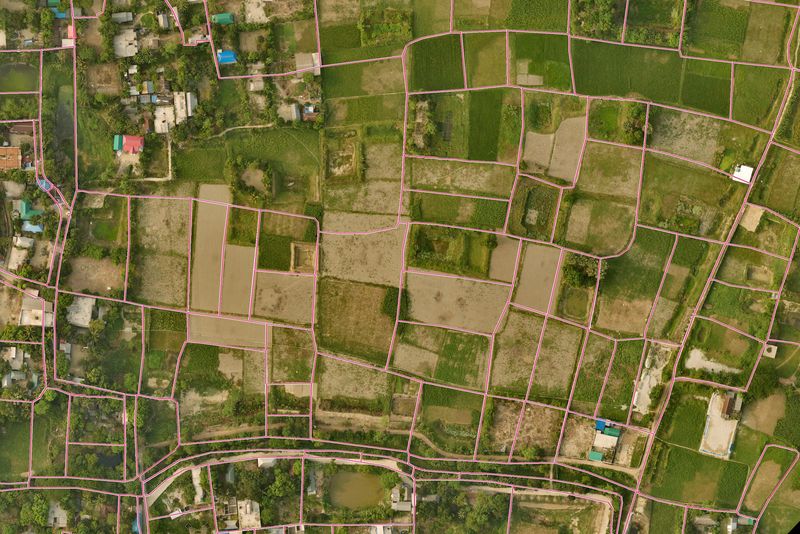
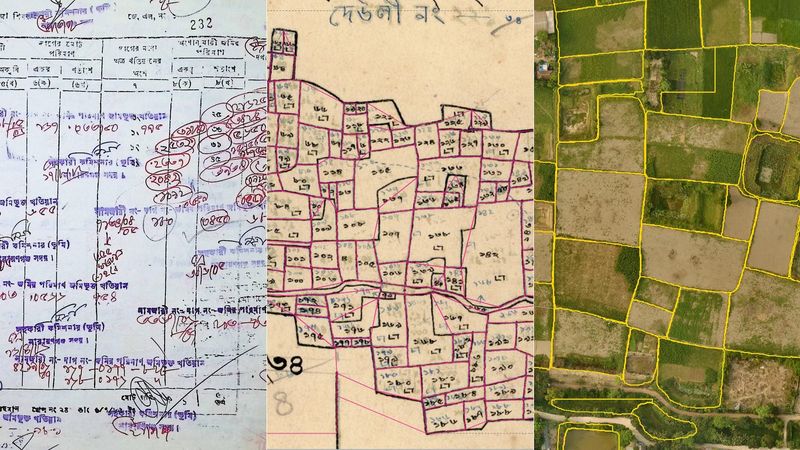
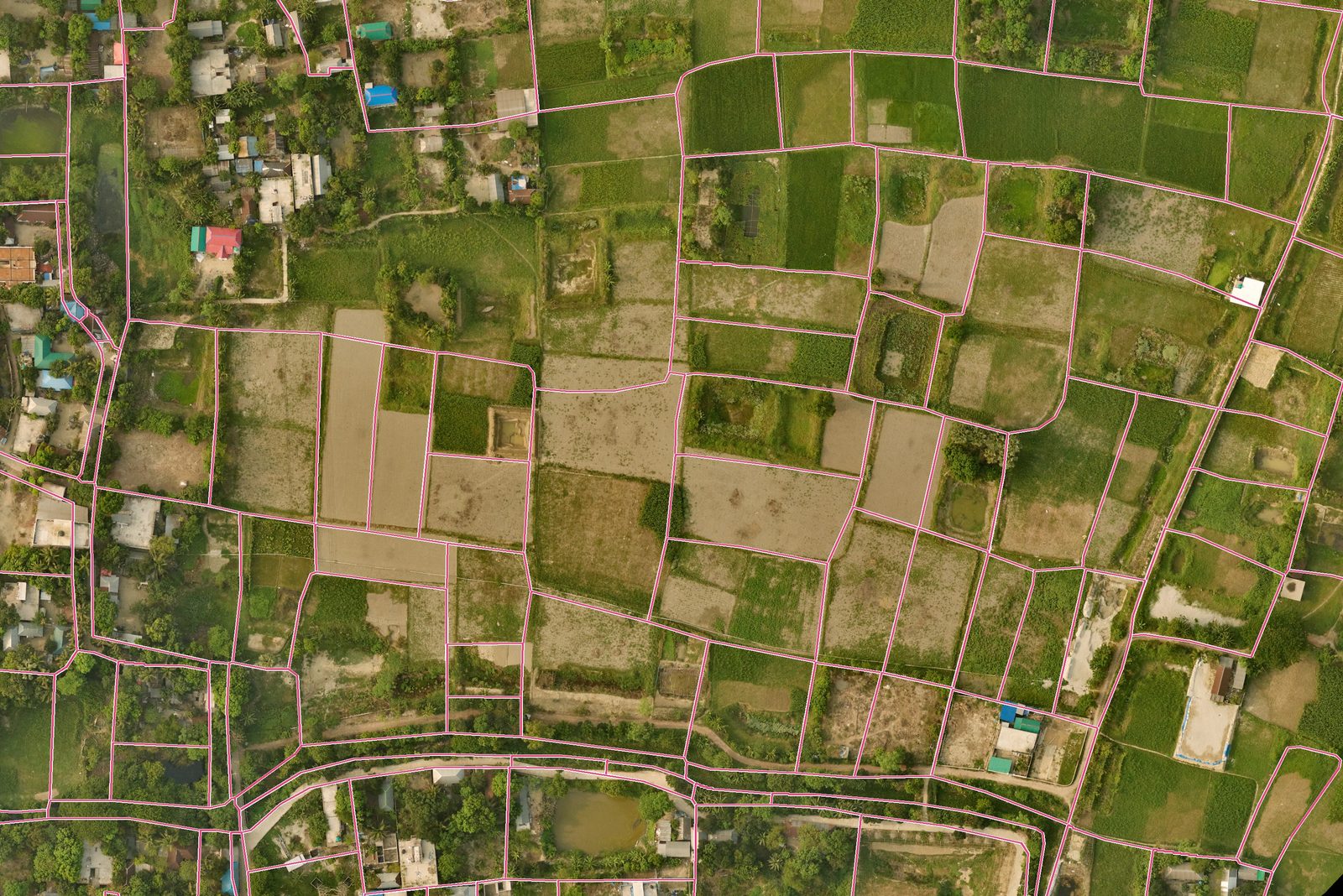
Each question has its own record. The khatian answers the first. The mouza map answers the second, though most sheets in use were drawn decades ago, many in the 1960s. The ground answers the third: the 2025 aerial photos we work with, taken at 10 centimetres per pixel, show houses, ponds and the bunds between paddy fields. Until now they have rarely been seen side by side.
What changes when the records are connected
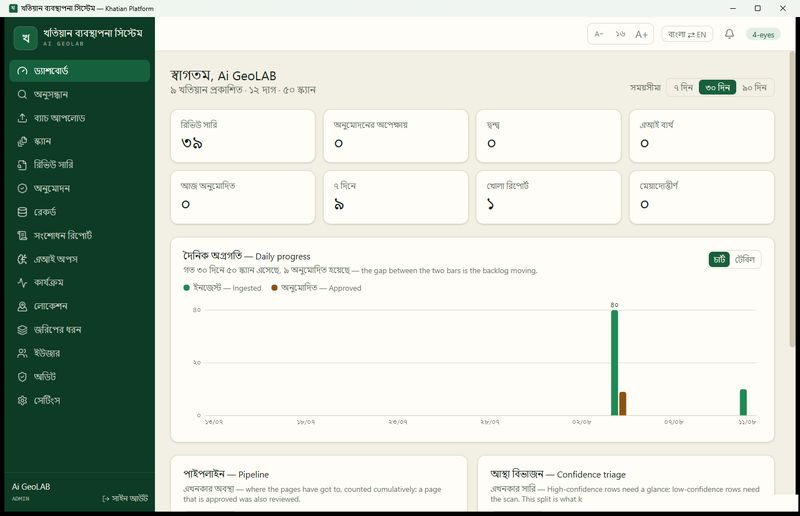
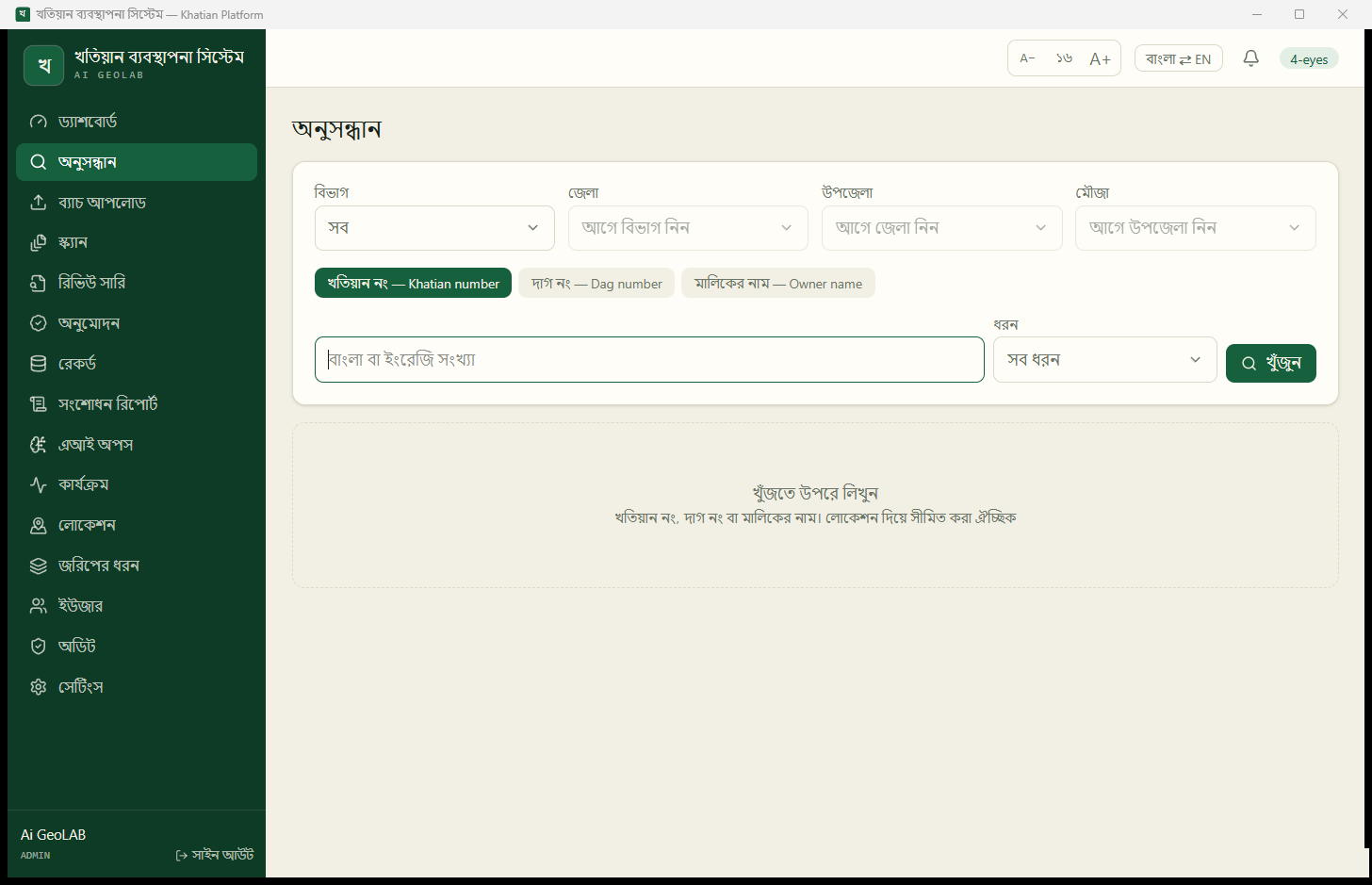
The Khatian Platform, our desktop application for land offices, brings the three together, with a model for each. One reads handwritten khatians, one turns scanned mouza maps into digital plots, and one outlines fields, ponds and homesteads in the 2025 photos. Connected, they let a land office check the land behind a mortgage against all three without anyone going to the record room. Four checks stand out.
Owner and share. A published record can be found by khatian number, plot number or owner name. Clicking a numbered plot on the map shows the active khatians that hold it in that mouza. The names and shares in a borrower’s papers can be set against the office’s own record, and any other active khatian that holds the same plot shows up too. Records not yet digitised and checked will not, and nor will heirs or buyers not yet recorded through mutation.
Area. Each plot on the digital map is an outline placed on the ground in its real position, so its area can be measured. If the papers put more land in a plot than the plot as drawn can hold, someone needs to explain why. On 22 mouza sheets it had never seen, our map model found 95 percent of the plots, and found and read the correct number for 81 percent of all plots. That is why a reviewer confirms or fixes every boundary and number against the scan.
Use on the ground. The khatian records a class of land, such as homestead or arable. When a plot is selected, the platform can show the fields, ponds and homesteads our imagery model found on that ground in the 2025 photo. If the record says homestead and the photo shows a pond, the valuer and the credit officer have something to discuss. Two limits apply. The imagery model works well on farmland and poorly in towns, so the version we ship is for rural land only. And a 2025 photo shows the land as it was in 2025.
History. The platform has a place for every generation of khatian on Bangladesh Bank’s checklist, from the oldest survey records to the latest mutation khatian. Every change to a published record creates a new version, the old one is kept, and the platform records who changed what and when. We believe a record that changed shortly before a loan application deserves a second look.
None of these checks gives a verdict. Each turns up a mismatch for a person to look into, and the records are checked by people too. Our khatian model scored 93 out of 100 on the full record (owners, shares, plots and areas), on 200 khatians per test from mouzas it never saw during development (more on how we test). That is not 100, so every khatian it reads goes to a reviewer, a second person approves it by default, and the AI never publishes anything on its own.
What connected records do not replace
Connected records do not replace any of the checks a bank makes today: not the legal search, the NEC, registration of the mortgage, the lawyer’s opinion, the site visit or the enlisted valuer. A khatian is evidence of ownership, not proof of title. Under section 144A of the State Acquisition and Tenancy Act 1950, each entry in a survey record of rights is evidence, presumed correct until it is proved incorrect (Laws of Bangladesh). Digitising a record does not make it true either: a forged entry read from paper is still a forged entry. A connected record can show that the papers, the map and the ground disagree. It cannot say which is right. That stays with people.
The platform is built for the land office: it runs offline on one computer there, and no scan, record or map leaves that machine. How banks reach records checked this way, and on what terms, is for land offices and regulators to decide. Section 23 of the Land Crime Prevention and Remedy Act 2023 already calls for an interoperable, integrated database for obtaining and verifying land information, including information on land tied to loans from banks and financial institutions (Laws of Bangladesh). We believe records that people have checked, with their history kept, are what any such system needs first.
Why this matters for land valuation
A collateral valuation rests on the same three answers as any other. We believe that when a valuer and a credit officer start from the same checked record, mapped plot and recent photograph, a valuation is easier to test, and an inflated one is harder to pass. Connected records do not set a price. They give the people who do a firmer base.
If you work on credit risk, collateral or legal checks at a bank, we would like to hear which checks cost you the most time, and what you would need from connected records. Get in touch.
Related posts