AI is already on the agenda for Bangladesh’s land administration. The state news agency, Bangladesh Sangbad Sangstha (BSS), has reported plans to use it to detect forged documents and to stop the same land being sold more than once (BSS). Whatever the task, an office that brings AI into its record room has plain questions to answer before it asks how accurate the model is. Where do the records go? Who signs off? Can the staff use it in their own language? If a record turns out to be wrong, can anyone tell how?
We built the Khatian Platform around those questions. It is a desktop application that takes a land office from a pile of scanned pages to published, searchable records, with people in control of every step. This post, for government IT, procurement and land administration leaders, sets out where the platform fits, the five design decisions behind it, and what they mean for buyers.
Online services, and the paper behind them
Bangladesh has put a good deal of land administration online. Mutation (namjari), the updating of the record when land changes hands, now runs online as e-mutation in upazila (sub-district) land offices across 61 districts (The Financial Express), and the government has made it mandatory (BSS). When e-mutation won a UN Public Service Award in 2020, the UN reported that a mutation took 28 days instead of 60, with one visit to the office instead of three or four (United Nations). However, a 2022 review of ministry data found an average of 43 days, against a target of 28 (Prothom Alo, in Bengali).
Government figures put the number of e-mutation applications resolved by May 2026 at more than 10 million (BSS). Since February 2025, one registration on land.gov.bd, with a mobile number and national ID card number, opens e-mutation, land development tax payment, land records and maps (BSS).
The government is also surveying the land afresh. The Bangladesh Digital Survey, whose rollout was inaugurated in Chattogram in August 2023, uses satellites, drones and ground control stations. Its first phase covers 634 mouzas (মৌজা), the smallest revenue units, across 933 square kilometres (Bangladesh Post). It is a long task. On 1 October 2026, The Business Standard reported that 274 of the country’s 58,590 mouzas had been surveyed digitally since the work began in 2012 (The Business Standard).
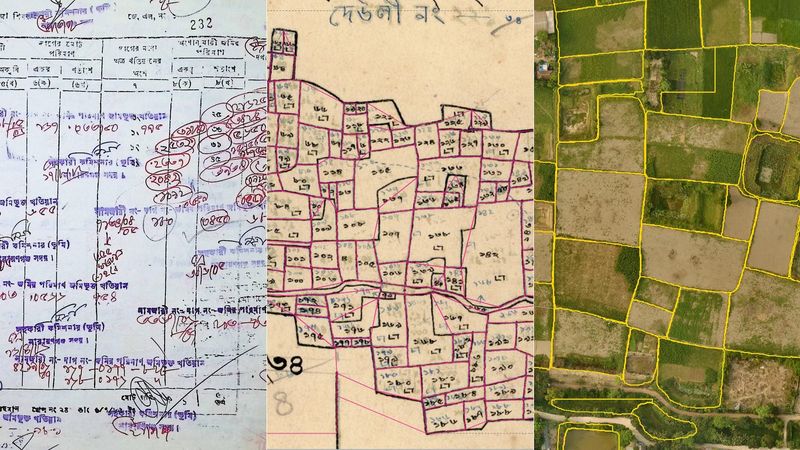
Behind all of this sits a paper archive. The khatian (খতিয়ান) is the record of rights to land. Land offices keep khatians in bound volumes, mouza by mouza and survey after survey, often with decades of handwritten mutation notes over the printed table. People still use the older ones to prove a chain of ownership. Next to them sit the mouza maps, many drawn in the 1960s. Our guide to Bangladesh’s land records explains how they fit together.
The Khatian Platform is built for that paper archive. We see it as working alongside the online services, not as a replacement for any of them.
It runs offline, on one computer
The whole platform, including the AI, runs on one computer in the office. No scan, record or map leaves that machine. There are three reasons for this.
The first is privacy. A khatian names real people and what they own. Bangladesh now has a Personal Data Protection Act, Act No. 63 of 2026 (Laws of Bangladesh). We do not give legal advice, and each office will take its own view of what the Act asks of it. What we can say is this: the records stay in the office.
The second is connectivity. An upazila land office with a weak internet connection can use the platform as well as an office in Dhaka. Work does not stop when the connection drops.
The third is control. We did not want a land office to have to choose between using AI and keeping its records in its own hands.
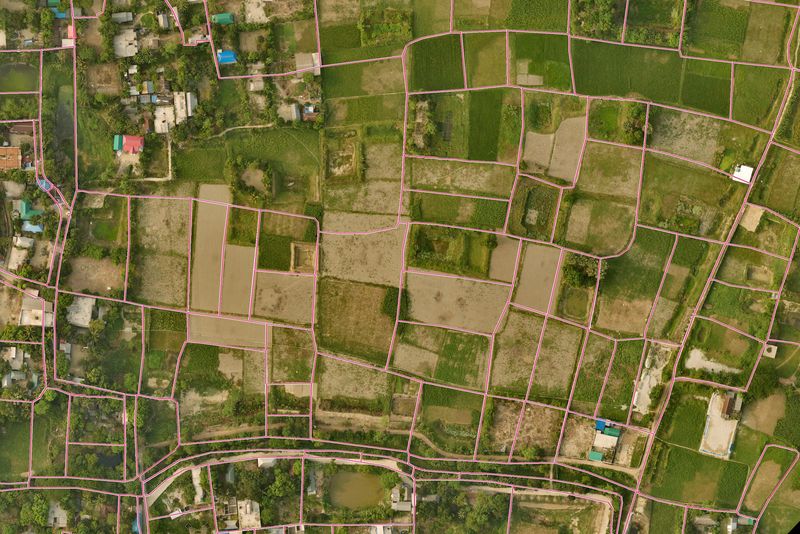
The platform does not need a data centre. Our mouza map model, for example, takes around a minute to outline a full sheet of about a thousand plots on a single desktop computer.
People approve, not the AI
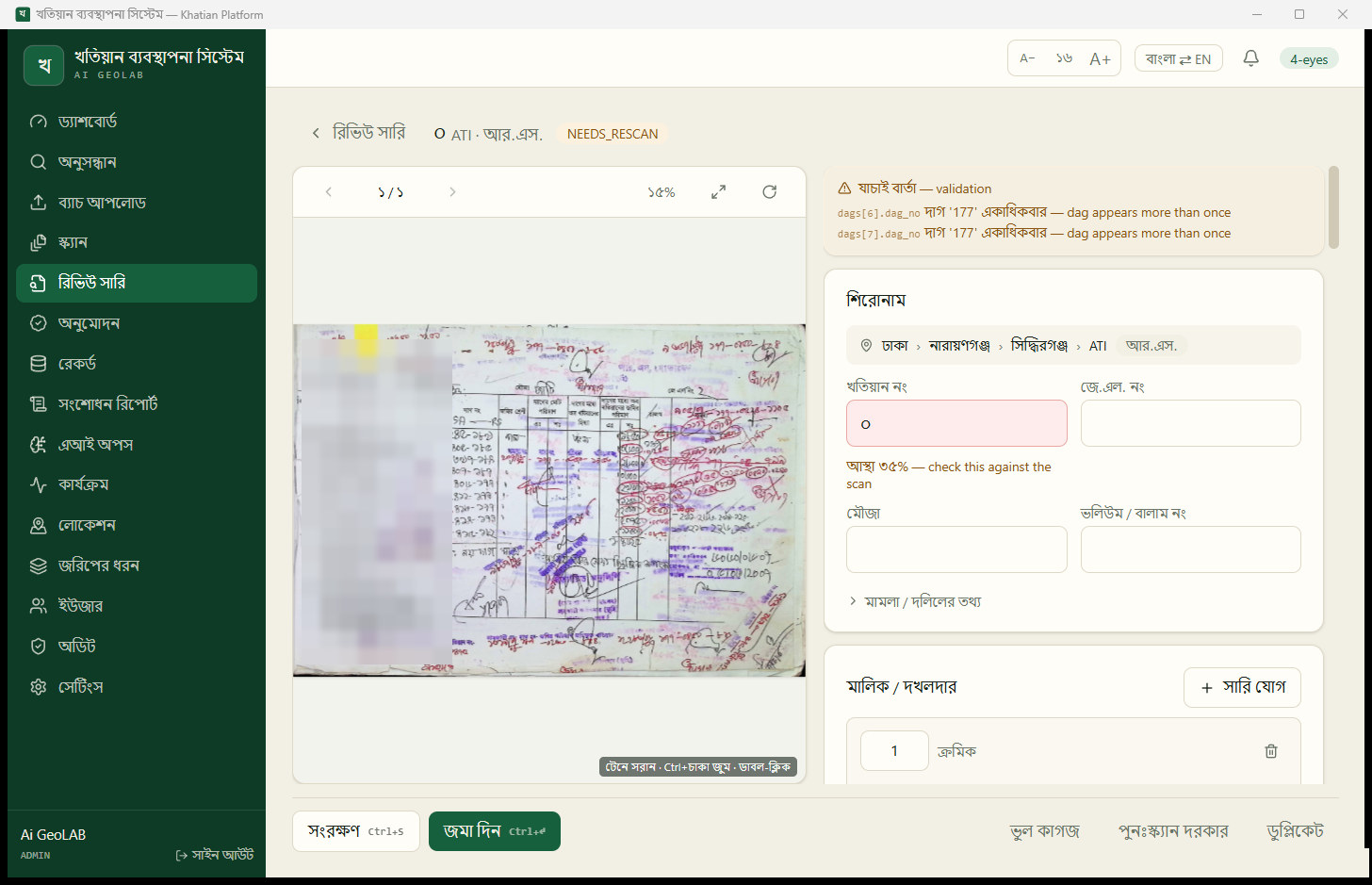
The platform reads every page and places each khatian in a review queue, already filled in. A reviewer checks it against the scan, which sits beside the fields on the same screen, and fixes what needs fixing.
Three safeguards help the reviewer. Fields the model is unsure about are highlighted, with a note to check them against the scan. A plot (dag) number repeated within one record is flagged before anyone can approve the page. And a page the model cannot read at all still lands in the queue for manual entry, so nothing is lost because the AI failed.
Then the four-eyes rule applies. By default, a reviewer cannot publish their own work: a second person, the approver, has to sign it off. Careful offices already work this way on paper, and the platform enforces the rule unless an office chooses to change that setting. Either way, the AI never publishes anything on its own.
We built it this way because the models are good, but not perfect. Our khatian model scored 91 out of 100 on the index fields (khatian number, plot numbers, mouza and upazila) and 93 out of 100 on the full record (owners, shares, plots and areas). It was tested on 200 khatians per test, from two collections, all from mouzas it never saw during development. Some pages are too damaged for anyone to read with confidence, and some handwriting is ambiguous even to an experienced clerk. Our post on how we test our models explains the tests and their limits. The model’s job is to make review fast, not to replace it.
It speaks Bengali first
The interface is in Bengali, with English one click away. Text size can be raised for anyone who needs it. Search accepts both Bengali and English numerals, so a clerk can type a khatian number as ১২৩ or 123 and find the same record.
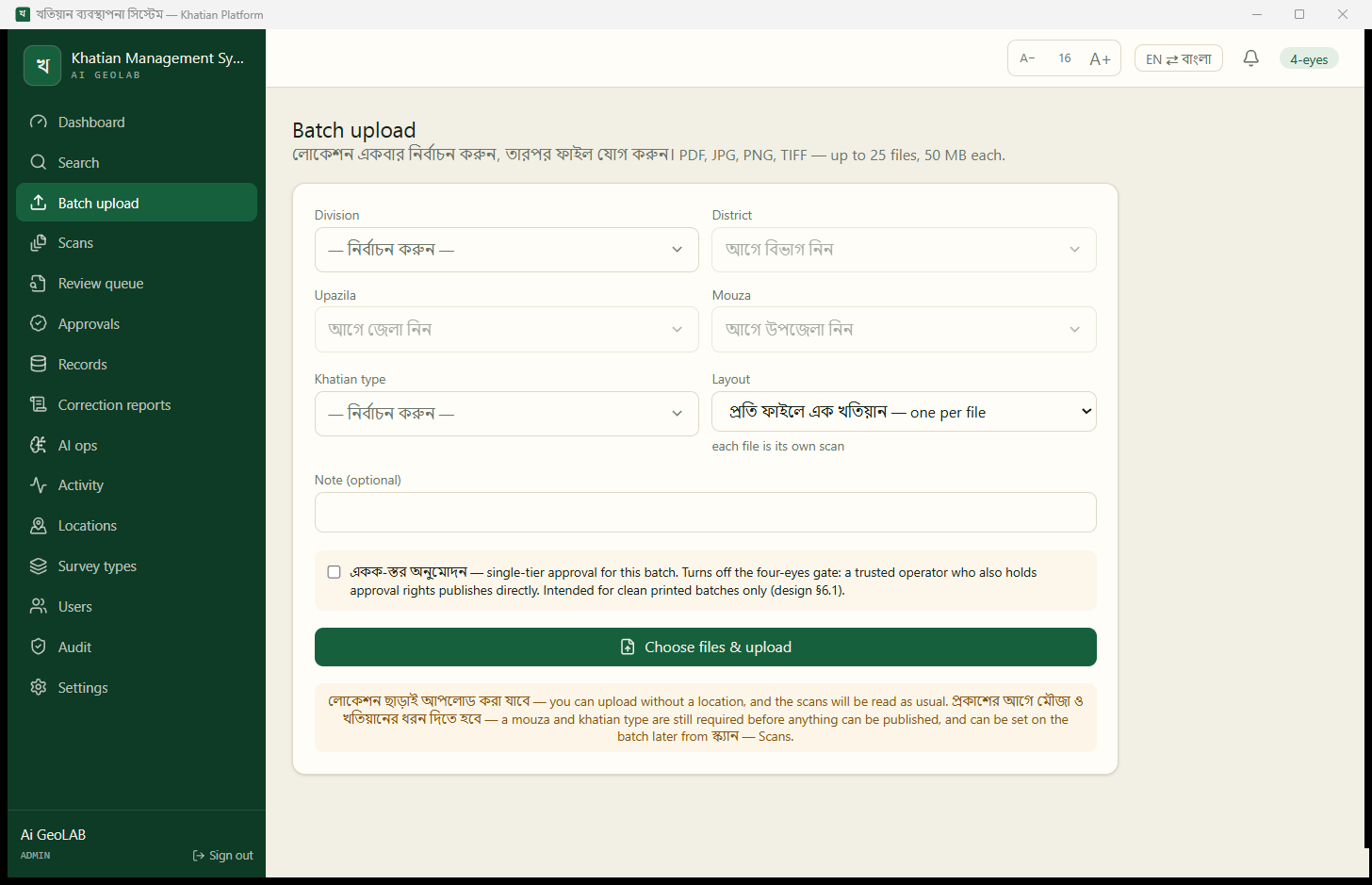
We believe this matters more than it sounds. A system that staff cannot use comfortably in their own language tends to be worked around rather than used.
Everything is traceable
Every change to a published record creates a new version, and the old version is kept. The platform records who changed what and when, so anyone checking a corrected record can see what it said before.
Each AI reading is also tied to the version of the model that produced it. When we improve a model, an office can tell which records the older version read.
This matters because land records are a target. In January 2026, the Ministry of Land asked citizens to check the QR codes on khatians and other land documents with its Bhumi app, saying that organised fraud rings were forging them (The Financial Express). A version history will not stop a forger by itself. However, every change to a published record has an author and a date, and the earlier version is still there to compare.
Work is visible
In our view, digitisation projects tend to stall in the middle. Scanning is fast, and a scan looks like progress, but someone still has to read it, check it and publish it.
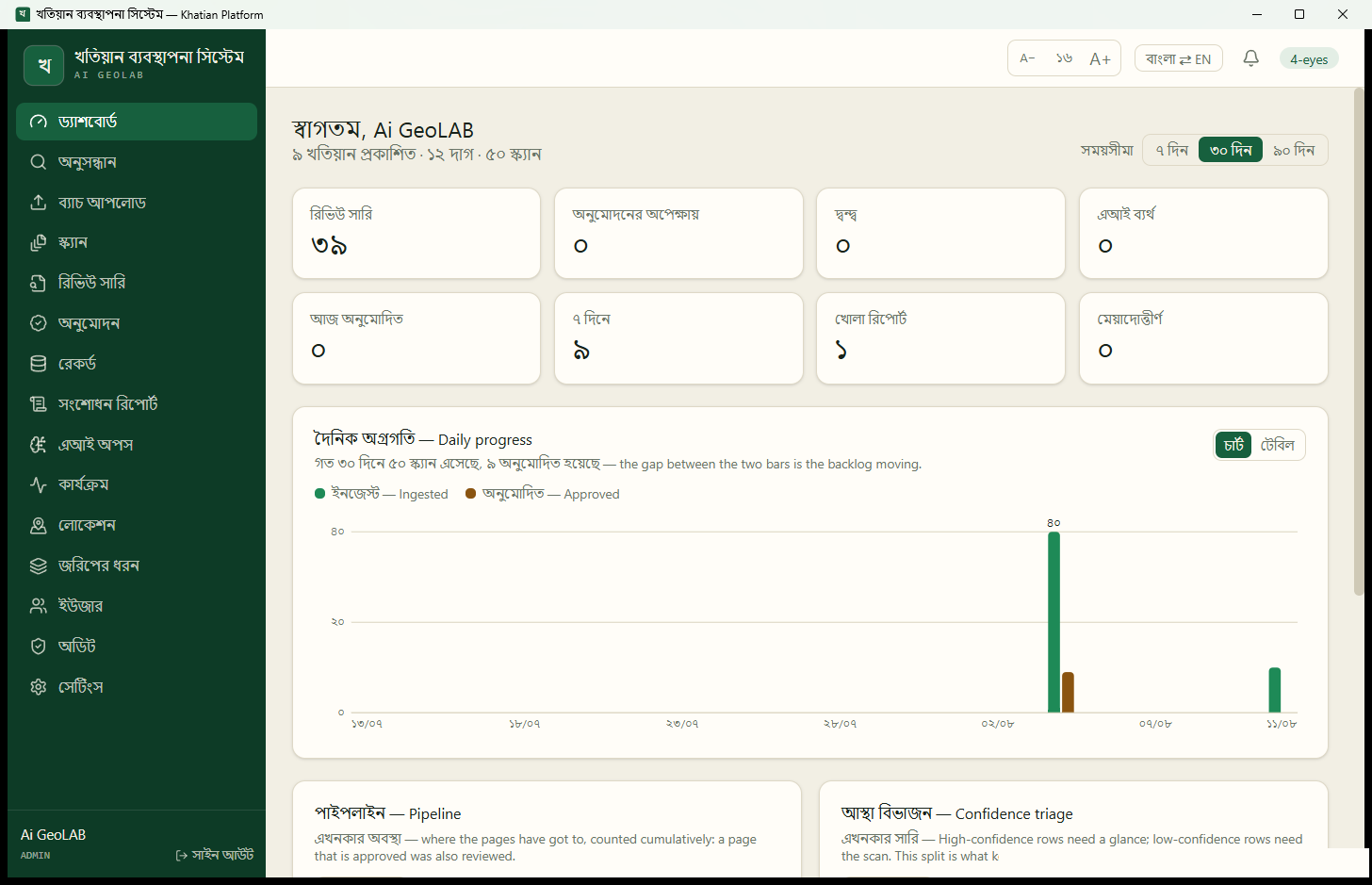
The dashboard shows how many records are waiting for review and for approval, and how much was scanned and approved each day. The activity page shows each operator’s reviews and approvals and their median review time. A supervisor can see where the backlog is without asking anyone.
Why this matters for land valuation
Valuation starts from records. In June 2025 the government announced plans to change how it sets the minimum value at which land can be registered, long fixed as mouza rates. Under the proposal, the minimum would follow the average value of all deeds for a land category over two years, and a mouza could be split into clusters where prices inside it differ (The Business Standard). A year later, the finance minister said the government had formed a committee to bring mouza rates closer to market values (Dhaka Tribune). Our post on the 2025 valuation rules explains what has and has not changed.
A method like this only works if each deed is tied to the right plot, class and area. We believe records that people have checked and approved, with their history kept, are records a valuer or a bank can build on. See how records, maps and photos come together for valuation.
What this means for procurement
For a buyer, these decisions change the shape of the purchase.
No cloud dependency. The platform and its AI run on one computer in the office, so there is no cloud service to buy.
The data stays in the office. Where the records are held has a simple answer: in that office.
People stay accountable. By default, two people see every record before it is published. After publication, every change is recorded against the person who made it, and every AI reading carries its model version.
To be clear about what the platform is: a tool for the record room, not a public website. It turns paper into checked, searchable records at the pace of the office’s reviewers, not its typists.
Whoever you buy from, we suggest asking five questions. Where do the scans and records go? Who publishes a record, a person or the AI? What happens to a page the AI cannot read? Can you tell which model version read a given record? Were the test scores measured on records from mouzas the model had never seen?
If you would like a demonstration, or want to put these questions to us, get in touch.
Related posts